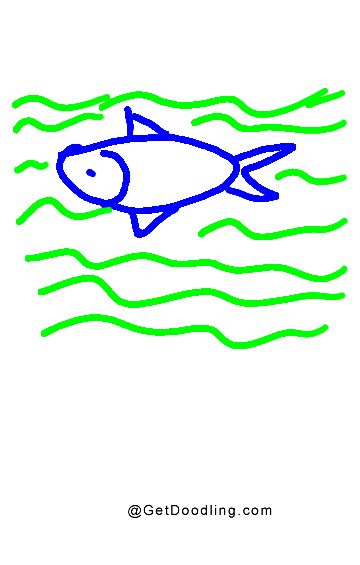
Fish Drawing
How to draw a fish — a simple goldfish, a koi or a cartoon fish — plus a free board to practise on right now.
A fish is the easiest animal on this page to draw, and the reason is its shape rather than its detail. It is the only animal you never have to turn towards you: a fish is always seen from the side, so there is no perspective to work out, no legs to balance, and no second eye peeking around the head. One flat outline does the whole job.
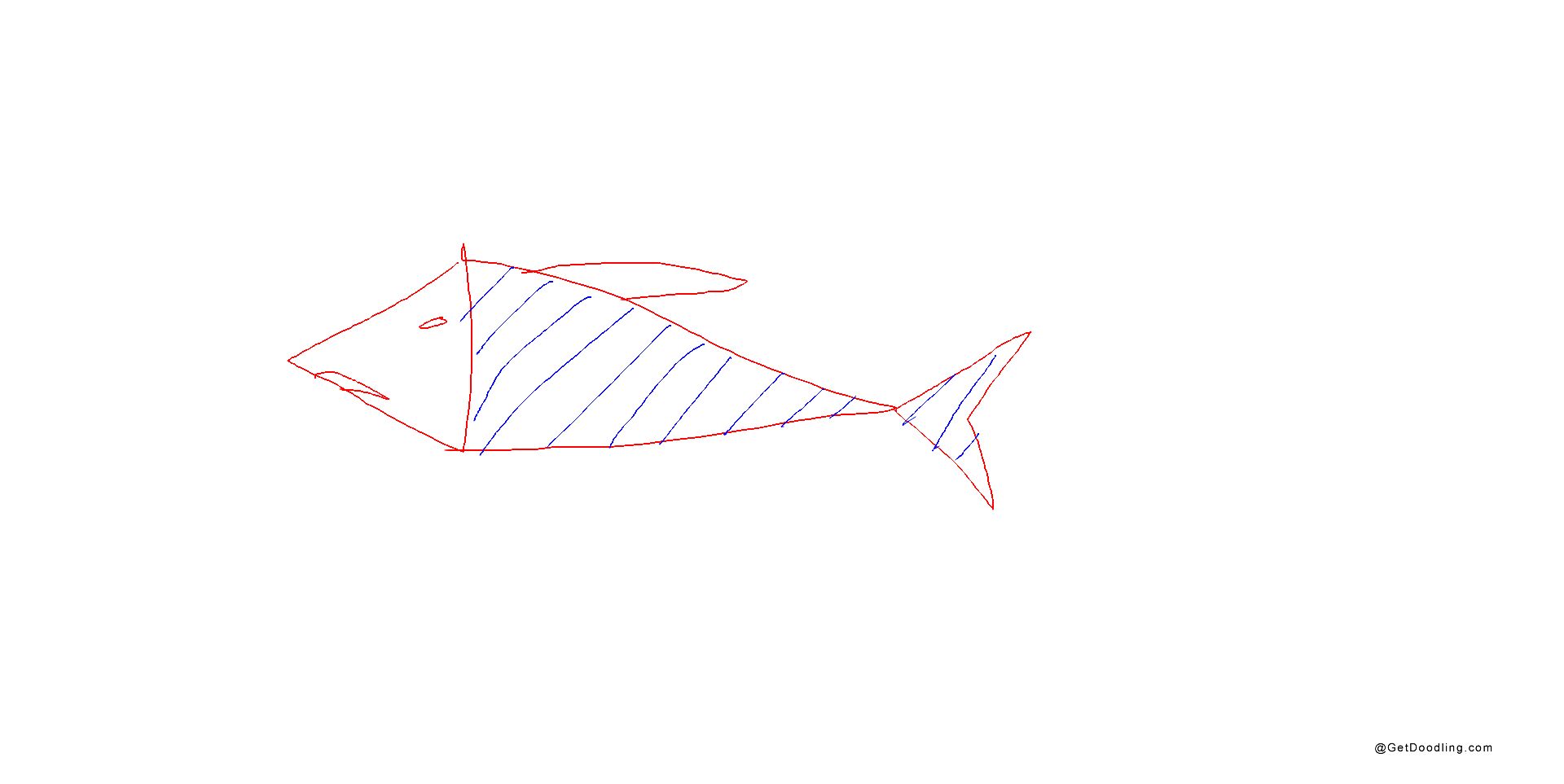
That outline is a leaf, not a circle. Draw an almond with both ends pointed — fat through the middle, tapering towards the nose and again towards the tail — and you already have something that reads as a fish before a single fin has been added. Start with a circle instead and you get a balloon: round, blank, and hard to rescue with fins afterwards.
The tail is where most fish drawings come apart. People draw the body and then attach a triangle to the back of it, as though the tail were a paper fan glued on. A real tail grows out of the fish — the body narrows to a point at the back and the tail flares from that narrowing. Draw the narrow point first, then let the tail widen out of it, and the drawing stops looking assembled.
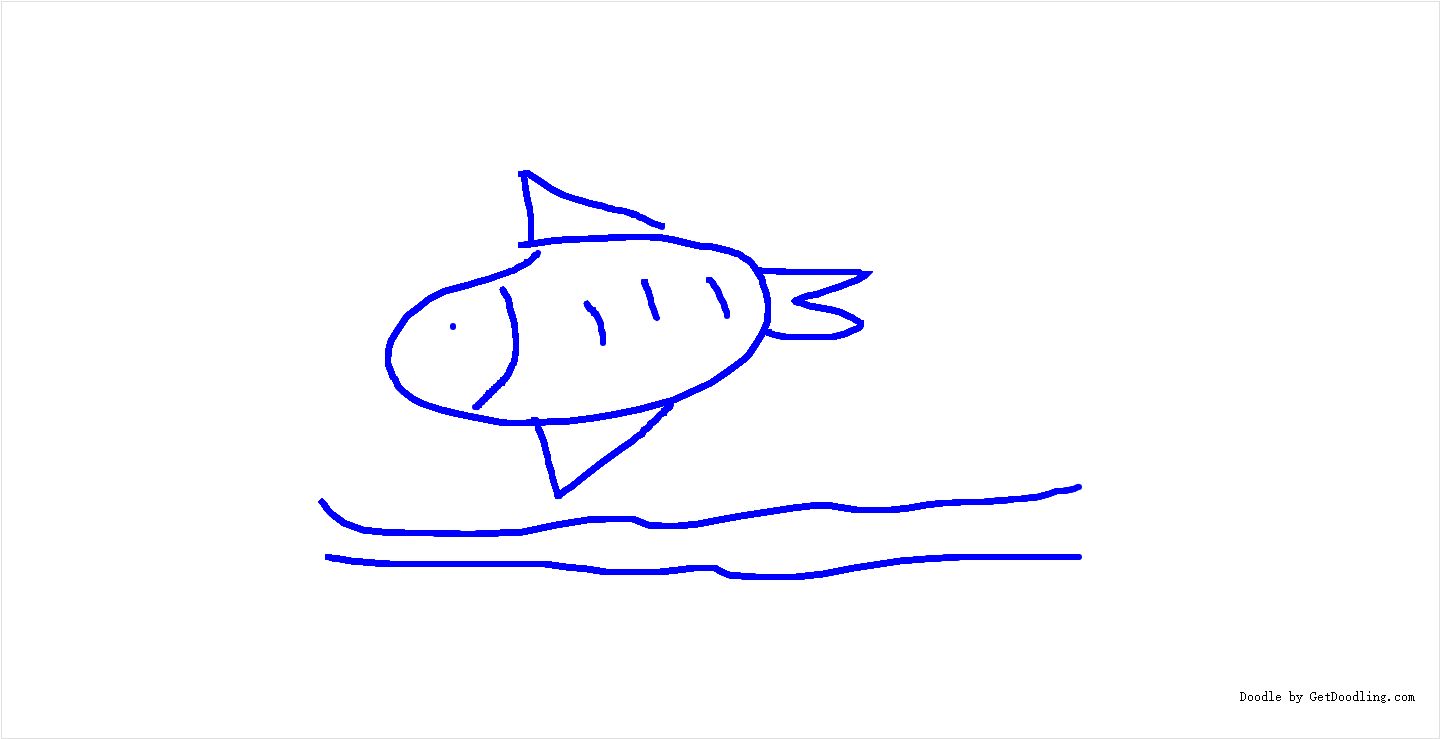
For an easy fish drawing, keep it to five things: the leaf-shaped body, a tail, one fin along the top, one underneath, and a small circle for the eye. Add a single curved line behind the head for the gill and the fish is finished. A simple fish drawing and a cute fish drawing are the same shapes at different settings — a rounder belly, more space around the eye, soft rounded fins instead of pointed ones. A cartoon fish drawing pushes that further still, with an oversized eye and a small open mouth.
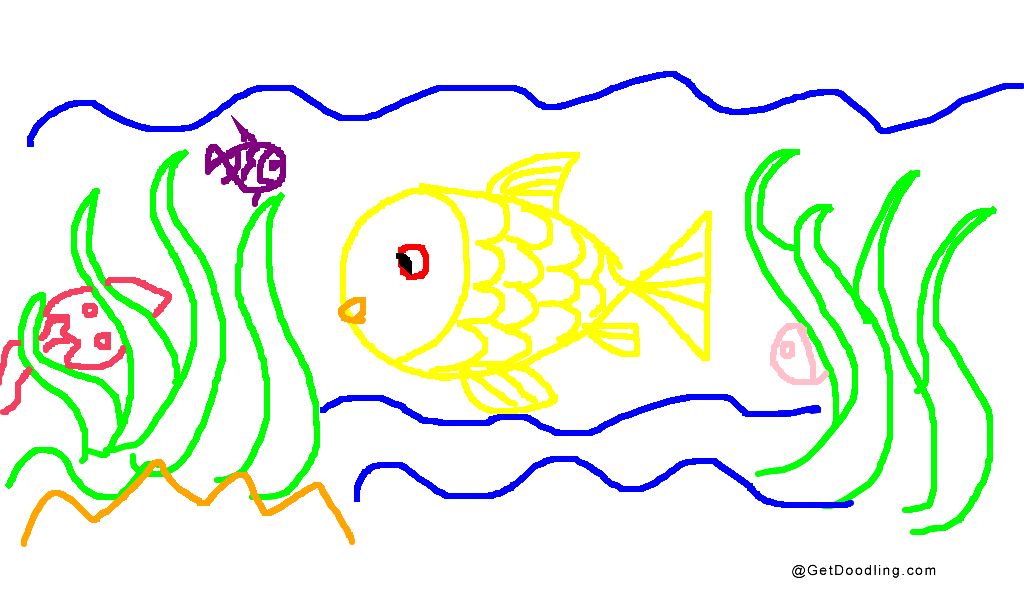
Once the body is right, the fins decide which fish you have drawn. A goldfish has a short round body and a long loose tail. A koi is longer and slimmer, with a scaled body, a pair of small whiskers at the mouth and a broad flowing tail. A betta has a small body and an enormous fan of a tail. A clownfish is rounded, with three white bands and fins that look painted on. A puffer fish is a circle with a face and a ring of small spikes. A realistic fish drawing goes further again — overlapping scales, a visible gill cover, shading along the belly — but the leaf is still underneath all of it.
You do not need anything to start. The board on this page opens in your browser, and you can draw with a mouse, a finger or a stylus. There are ten brush sizes and ten colours, and white works as an eraser on the white canvas — useful the first time a fin ends up the wrong way round. When your fish is finished, save it to your device as a PNG, or share it to the gallery so other people can see it.
Below are the steps for a simple fish, the things that make a fish sketch look better, and answers to the questions people ask most.
How to Draw a Fish in 5 Steps
-
Draw the leaf-shaped body
Start with a long oval, then bring both ends to a point — a rounded nose at the front, a narrower point at the back where the tail will go. Keep it flatter than feels natural: a fish body is closer to a leaf than to an egg, and a tall body turns into a balloon once the fins go on.
-
Add the tail at the narrow end
From the point at the back, draw two lines that curve outwards and then back in — a fan, a fork or a soft rounded brush, depending on the fish. The tail should meet the body at a single narrow point, never along a flat edge. Forked tails read as fast fish; wide soft tails read as goldfish and betta.
-
Add one fin on top and one underneath
A triangular fin sitting along the top of the back, and a smaller one underneath, roughly opposite it. Keep both bases short — a fin joins the body along only a small part of it, not stitched along the whole length. Point the tips backwards, in the direction the fish would swim, and the drawing starts to look like it is moving.
-
Add the eye and the gill line
One eye only: a small circle set high on the head, just behind where the nose comes to a point. Seen from the side, a fish never shows a second eye, and drawing one anyway is the most common mistake in fish drawings. Then a shallow curve behind the head, from the top of the body down towards the belly, for the gill cover.
-
Add the scales and the fin lines
Three or four short curved lines across the middle of the body suggest scales without filling in a pattern. Inside each fin, draw three or four thin lines fanning out from the base towards the tip for the fin rays. Finish by checking the whole silhouette — a fish is smooth, so any line that leaves a bump on the outline should be softened or erased.
Fish Drawing Tips
A leaf, not a circle
Almost every fish drawing that looks wrong began with a body that was too round. A fish is longer than it is tall, with both ends tapering to a point. If your outline looks like a balloon or an egg, flatten it before adding anything else — fins drawn onto a round body never rescue it.
The tail starts at a point
The body narrows towards the back and the tail flares out of that narrowing. Draw the tail as a triangle attached to a flat edge and the fish looks assembled rather than alive. Draw the narrow point first, let the tail open out of it, and check the two meet in one place rather than along a seam.
Fins flow backwards
Fins are dragged by the water, so their tips and trailing edges point away from the head. A fin with its points facing forwards looks stiff, and the fish looks as though it is reversing. Keep the base short where it joins the body and leave the far edge loose and uneven.
One eye, set high
From the side there is exactly one visible eye, sitting high on the head and closer to the nose than to the tail. Keep it small — an oversized eye turns the drawing into a cartoon, which is right if that is what you want and wrong if it is not. Add the mouth as a single short line at the very tip of the nose.
Change the fins, change the fish
Draw the same leaf five times and vary only the tail: a wide soft fan for a goldfish, a long flowing one for a betta, a forked one for a fast open-water fish, a short rounded one for a puffer, and a broad trailing one for a koi. The body does almost none of the work — the fins tell you which fish you have drawn.
Fish Drawing FAQ
How do you draw a fish step by step?
Five shapes, in this order: a leaf-shaped body with both ends pointed, a tail flaring out of the narrow end, one fin along the top of the back and a smaller one underneath, a single eye high on the head, and a curved line behind the head for the gill. Scales and fin lines come last, once the silhouette is right. Draw them in that order and nothing has to be repositioned later.
How do you draw a simple fish?
Keep the body long and flat rather than round, add a soft rounded tail, one fin on top and one below, and a small eye — then stop. A simple fish drawing and an easy fish drawing are the same five shapes, and neither needs scales or shading. For a cute fish drawing, round the belly slightly, widen the gap between the eye and the nose, and soften every fin tip. A kawaii fish drawing does the same thing one step flatter, with an oversized eye and no gill line at all.
How do you draw a koi fish?
A koi is a long, slim version of the same body — about four times as long as it is tall, with a gently curving spine rather than a straight one. Add a pair of short whiskers at the tip of the mouth, a broad trailing tail, and two or three small dorsal fins instead of one. Then, for the scales, draw a few curved lines that overlap like roof tiles across the upper half of the body and leave the belly clear. Keep the fins loose and flowing rather than sharp.
How do you draw a goldfish?
A goldfish is the shortest, roundest body in the family, with a long soft tail that trails well behind it — so start with a shorter leaf and let the tail be nearly as long as the body. A clownfish uses the same rounded body with three white bands painted across it and small fins, and its tail is much tidier. A betta is a small body with an enormous fan-shaped tail, so the tail does most of the drawing. A puffer fish is the odd one out: draw a circle with a small face low and forward, then a ring of short spikes around the outside.
Why does my fish look like a balloon?
Because the body was drawn round instead of long. A fish is a leaf — flatter than it is tall, tapering to a point at both ends — and fins added to a circle can never rescue it. Flatten the body, sharpen the nose, and make sure the tail flares from a narrow point rather than sitting on a flat edge. If you want a cartoon fish drawing, the round body is the right choice, but then commit to it fully: an oversized eye, a small open mouth, and fins drawn as simple rounded shapes. A realistic fish drawing goes the opposite way — a longer body, overlapping scales, a shaded belly and a visible gill cover.