Animal Drawing
How to draw an animal — a cat, a horse, a rabbit or anything else with four legs — plus a free board to practise on right now.
Drawing an animal is not really about drawing a species. Almost every four-legged animal is built from the same few shapes: an oval body, a round head, and four legs. What changes between a cat, a horse, a rabbit and a bear is nothing but proportion. Once you see that, you stop learning one animal at a time and start drawing all of them from the same handful of marks.
The skeleton is three shapes. An oval lying on its side for the body, a circle for the head, and a short line joining the two for the neck. Draw those three and you have already decided whether your animal is long-bodied or compact, big-headed or small. Add four legs and the outline is complete. At this point you have not drawn an ear, an eye or a single hair — and the drawing already reads as an animal rather than as a blob.
Proportion does the naming. Take that same oval, the same circle and the same four legs, and then: shorten the legs and enlarge the head and you have a cat, a rabbit or a puppy; stretch the legs and lengthen the neck and you have a horse or a giraffe; widen the body and square off the head and you have a bear; round everything and shrink the tail and you have a pig. This is why learning to see proportion is worth more than memorising a hundred separate tutorials — and why an easy animal drawing is mostly a question of getting the head-to-body ratio right before adding anything else.
The second thing that decides whether an animal drawing looks right is the legs. Drawn as four evenly spaced pillars, they look like a table. In a side view, the two near legs and the two far legs sit at different points along the body, and the far ones are drawn shorter and higher, often partly hidden behind the near ones. That one adjustment gives a flat drawing depth, and it does it without any shading at all.
For an easy animal drawing, keep the body, the head and the legs, and skip everything else. A simple animal drawing, an easy animal sketch and a cute animal drawing are the same few shapes at different settings — a larger head, a shorter body, rounder paws. Nearly every list of cute animals to draw comes down to one trick: take a real animal and give it puppy proportions, and almost anything becomes cute. A cartoon animal drawing pushes that further, with an oversized head, tiny legs and simple rounded paws. A realistic animal drawing goes the other way: grouped fur instead of outlines, a shaded belly, and legs that look as though they are carrying weight. Kawaii animal drawings sit at the flattest end of all — an oval body, a round head, dot eyes, and not one unnecessary line anywhere.
You do not need anything to start. The board on this page opens in your browser, and you can draw with a mouse, a finger or a stylus. There are ten brush sizes and ten colours, and white works as an eraser on the white canvas — useful the first time a leg comes out the wrong length. When your animal is finished, save it to your device as a PNG, or share it to the gallery so other people can see it.
Below are the steps for a four-legged animal, a set of easy animals you can try one after another, the things that make an animal sketch look better, and answers to the questions people ask most.
How to Draw an Animal in 5 Steps
-
Draw the body as a sideways oval
A long oval lying flat on the page, not a circle. How long you make it decides how heavy your animal looks: a short oval reads as a cat or a rabbit, a long one as a horse or a dog. Tilt it very slightly so one end sits a little higher — a body drawn perfectly level looks like it is standing on a shelf.
-
Add the head and join it with one line
A circle for the head at the higher end of the oval, roughly a third to a half of the body's length depending on the animal you have in mind. Join the two with a single curve from the top of the head down to the back rather than drawing a full neck — most four-legged animals have almost no visible neck in a side view. If your oval and your circle overlap as two complete shapes, the result looks like a snowman rather than an animal.
-
Place four legs, not two
Legs first as single lines, before you give them any thickness. Put the two near legs at roughly the front and back of the oval, and the two far legs a little way inside those, closer to the middle. Draw the far pair shorter and stop them higher up. Only when all four sit where you want them should you draw the second line of each leg and make it a shape — that second line should bend slightly at the knee rather than running straight down.
-
Thicken the legs and add the paws
Now give each line a second one alongside it, close enough that the leg stays thin, and run the pair down to the ground rather than letting them trail off in the air. Make the near legs noticeably thicker than the far ones — twice as wide is not too much — because that difference is what tells the eye which pair is in front. Bend every leg once, partway down: forward on the back legs, back on the front ones, which is roughly how a four-legged animal stands. Then add the paws as small rounded shapes rather than blocks, with two or three short strokes for the toes. A paw drawn as a square foot turns a horse into a table leg.
-
Add the ears, the tail and the face
Ears sit on the top corners of the head, and which way you point them does half the characterisation: forward and rounded for a dog, upright triangles for a cat, long and flopping for a rabbit, small and round and set wide for a bear. The tail comes off the far end of the body and is usually about half the body's length. For the face, keep it minimal — two small dots or circles for the eyes, sitting on or just below the middle of the head, then a small nose with a short line down to the mouth. A face packed with detail reads as fussy at this size; two dots and a nose reads as an animal. Finish by rubbing out the parts of the oval and the head circle that now sit inside the drawing, and smoothing any bump where the two shapes meet. You should be left with one continuous outline and no visible seams.
Easy Animals to Draw
Cat
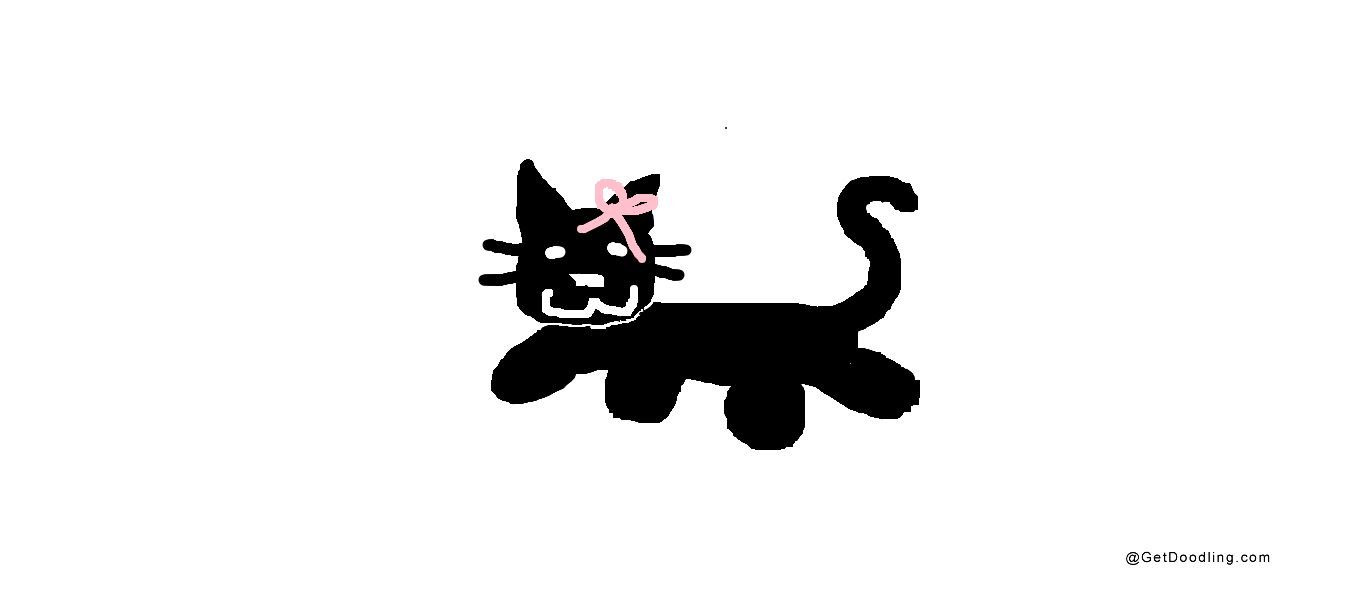
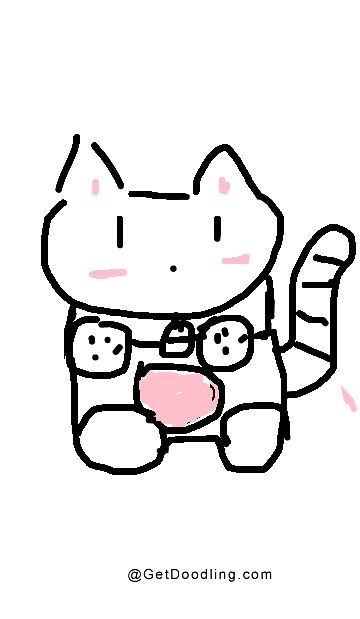
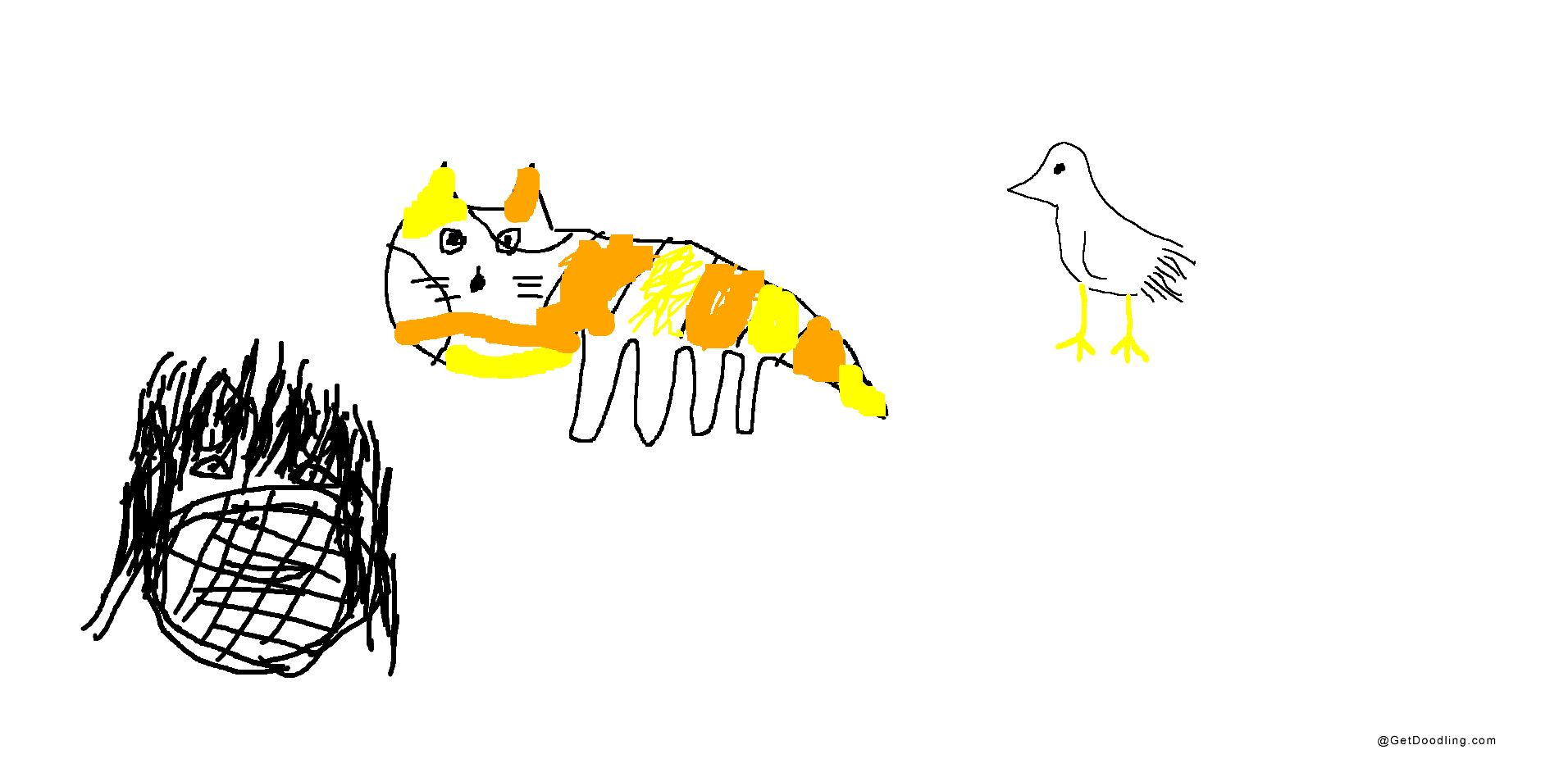
Start from a short oval, barely longer than it is tall, then add a large head — about two-thirds the length of the body. Round everything off, shorten the legs to little more than stubs, and give the tail some curve. Two upright triangles for the ears and a wide flat face put the whole thing in place. For a cute cat rather than a realistic one, push the head bigger and the legs shorter until the proportions look almost wrong on paper; on screen they will look right.
Dog
A dog is a cat with a longer body, longer legs and a muzzle at the front of the head. Draw the oval longer than the cat's, keep the head slightly smaller, and push a small rounded snout out of the head circle before you add the ears. Flopping ears that hang below the head are enough on their own to stop it reading as a cat. Point the same ears upwards instead and the animal turns into a fox.
Rabbit
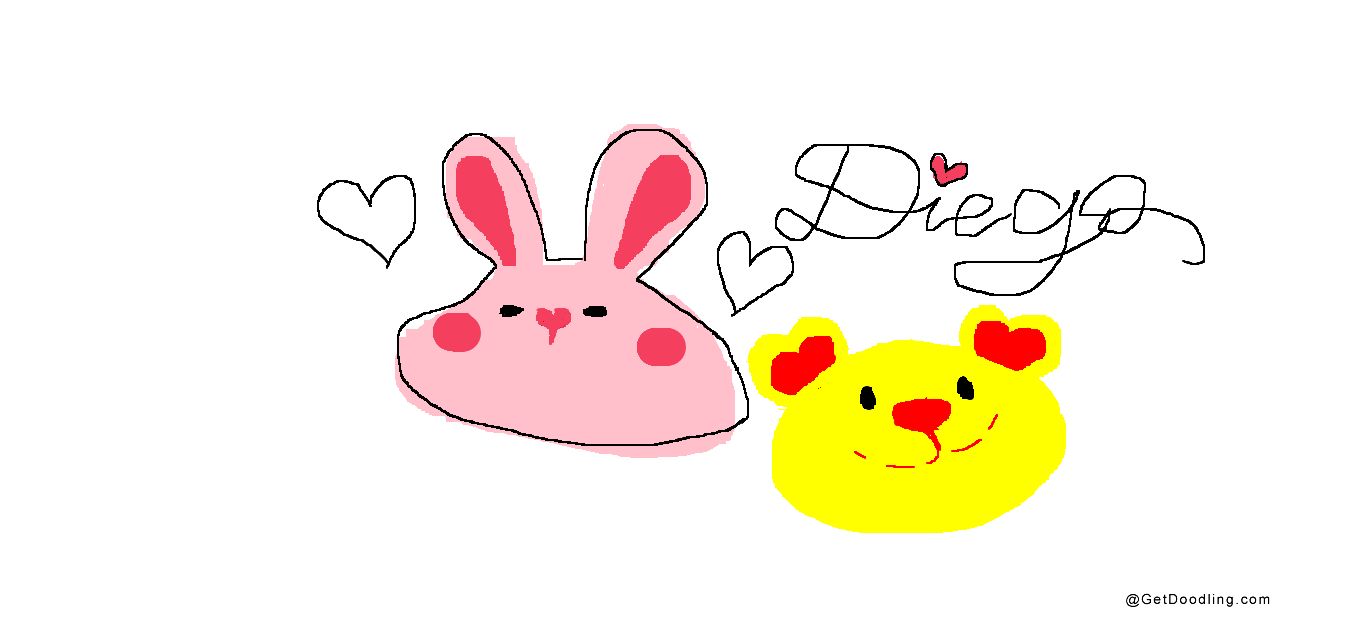
Body round and crouched, head small, and the back legs much longer than the front ones — fold them so they zigzag rather than running straight down. Then the ears: two long ovals standing up from the top of the head, each roughly as long as the head itself, plus a short round tail. A rabbit is mostly a pair of ears and a pair of haunches, so if those two things are right, almost nothing else matters.
Bear
Take the basic recipe and widen it. A broad oval body, legs short and thick, a squarish head with small round ears set out on the corners, and almost no visible neck at all. Skip the tail, or leave it a tiny stub. Bears read as heavy because of that width and the missing neck rather than because of size, so keep the legs stumpy however long you make the body.
Horse
Here the proportions flip: legs longer than the body is deep, a long neck, and a long head ending in a muzzle. Begin with a longer oval, then draw the neck as two long lines rising and reaching forward instead of one short curve, and set the head at the end of it at a slight angle. The legs need the bend described above, and they need to stay thin — a horse drawn with thick legs becomes a cow. Finish with a tail of long strokes hanging from the far end of the body.
Pig
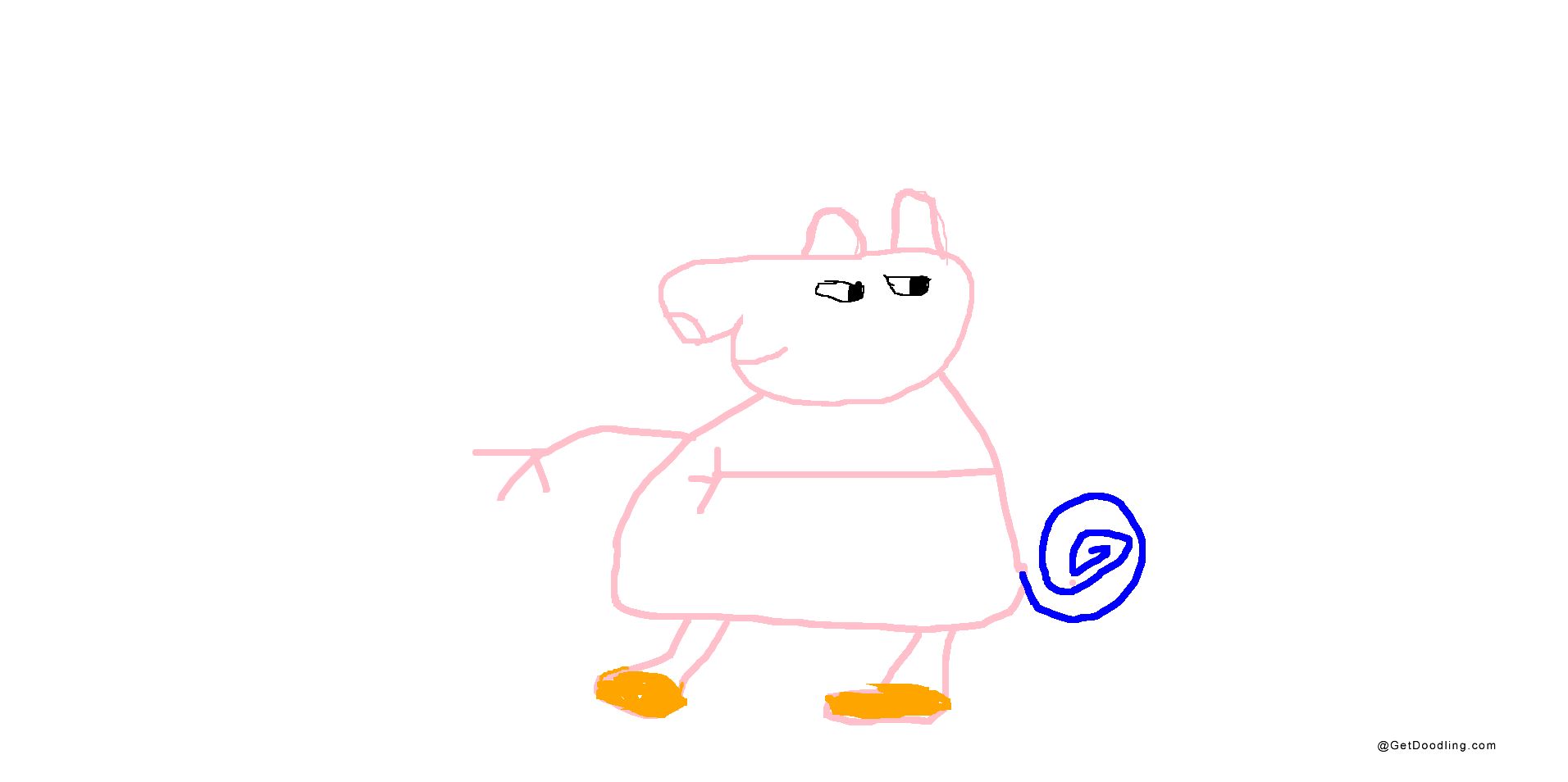
An oval almost as round as it is long, a circular head sitting straight on the front, four short legs and a small curly tail. The snout is a flat oval across the front of the head with two dots on it, and the ears flop forward over the forehead. Everything soft and nothing pointed — the rounder you make it, the more it reads as a pig rather than a dog.
Two of these drawn from the same three shapes is enough to see how the rest follow, and it is also the quickest way to build a list of animal drawing ideas: pick an animal, decide how long the legs are, how big the head is and whether there is a neck, and you have the recipe before you have drawn anything. For cute animals to draw, wide heads and short legs do most of the work; for a simple animal drawing, cut the face back to two dots and stop there.
Animal Drawing Tips
Same shapes, different numbers
Almost every four-legged animal is built from one oval body, one round head and four legs. What makes it a cat rather than a horse is the numbers you give those shapes, not the amount of detail you put on them. Before you draw anything, settle three ratios: how long the body is against how tall it is, how big the head is against the body, and how long the legs are against both. A cat is roughly a two-to-one body, a head about two-thirds of the body's length and legs about half its height. A horse flips all three. Decide those numbers first and the drawing almost draws itself; leave them to chance and no amount of detail will rescue it.
Four legs, not four pillars
A table has four legs, and it is drawn exactly the way most beginners draw an animal: evenly spaced, all the same length, all reaching the same line on the ground. That is what makes the drawing read as furniture. In a side view the two near legs and the two far legs sit at different points along the body, so put the far pair a little further in towards the middle, make them noticeably shorter, and stop them higher up the page — they are partly hidden behind the near pair and largely disappear into the belly. Then bend each leg once, partway down, and make the near legs about twice as thick as the far ones. Nothing else in the drawing gives depth that cheaply.
Ears and tail carry the species
Once the body and the legs are right, the animal could be almost anything. The ears and the tail finish the identification, and they cost two minutes. Upright triangles give you a cat, ears hanging below the head a dog, two long ovals standing straight up a rabbit, small round ears set out on the corners a bear, and a tail of long hanging strokes a horse. Push the same ears up instead of down and the dog reads as a fox; shorten the snout, round the ears and flatten the face and the fox reads as a cat. If your drawing looks like the wrong animal, it is almost always these two features rather than the body.
Cute is a setting, not a style
A cute animal drawing is not a different technique — it is the same proportions pushed hard in one direction. Make the head nearly as big as the body, shorten the legs to stubs, round the paws into soft blobs, drop the eyes lower and set them wider apart, shrink the muzzle and remove the neck entirely. Do that and almost anything reads as cute: cats, bears, birds, even animals that are not cute in life. A kawaii animal drawing is the same setting at its flattest extreme — an oval body, a round head, two dot eyes, and not one line that is not doing work. Where people go wrong is enlarging the head but leaving the legs at their realistic length, which gives you an animal on stilts.
Group the fur, then leave most of it out
A realistic animal drawing rarely fails from missing detail; it fails because the outline was drawn with a hairy edge. A jagged silhouette reads as a bad cut-out, not as fur, and it gets worse the more strokes you add. Keep the outline smooth and group the fur instead: four or five soft shapes around the chest, the haunches and the base of the tail are enough to say "fur" without a single hair. Then shade one side only — under the belly, where the legs meet the body, and along the underside of the tail. Turning a pencil on its side and dragging it is faster and more convincing than trying to draw individual hairs, and it keeps the finished animal readable at a glance.
Animal Drawing FAQ
How do you draw an animal step by step?
Five stages. First a long oval lying flat on the page for the body, tilted very slightly so one end sits a little higher. Then a circle for the head at the higher end, joined to the body with one smooth curve down the back rather than a full separate neck. Then four legs, placed as single lines before they are given any thickness — the two far ones drawn shorter and stopping higher up. Only then do the legs get a second line, a bend at the knee and a rounded paw. Finally the ears, the tail and a face of two dots and a nose. The whole point of the order is that proportions are settled while everything is still loose lines, and the surface details come last.
How do you draw a simple animal?
Body, head, legs, ears, tail, two dots — and then stop. A simple animal drawing, an easy animal drawing and an easy animal sketch are the same few shapes at the same settings; none of them needs fur, shading or toes, and cutting the face back to two eyes and a nose makes the drawing look more confident rather than less finished. The easiest place to start is a cat or a rabbit, where the short legs and generous head hide proportion errors, and the hardest is a horse, where long legs expose every mistake. The recipe does not change for a wild animal drawing either: a lion is the cat recipe with a wider chest and a mane drawn as one grouped shape, and it is the mane, not the body, that makes it read as a lion rather than as a large cat.
How do you draw a cute animal?
Enlarge the head until it is roughly as big as the body, shorten the legs until they are barely longer than the paws, round off every corner, slide the eyes down and out towards the sides of the head, and take the neck out altogether. That is the whole method, and it works on anything — the animals people most often want in this style are cats, rabbits, bears, puppies and foxes, and they are popular precisely because they already have big heads and short legs in life. If it still looks like a realistic animal wearing an oversized head, the legs are the problem: shorten them again rather than adding more detail. For the flat kawaii version, do the same and then remove every line that is not the silhouette, an eye or a nose.
How do you make an animal sketch look right?
A sketch is about proportion, so work loosely and work it out on the page. Draw the oval body and the head circle several times in a row, quickly, adjusting the ratios each time, and stop as soon as one of them reads as the animal you had in mind — that takes thirty seconds and saves an hour of fixing a wrong drawing. Keep the pencil light at this stage, because these first lines get erased. For an animal line drawing, run a single unbroken line around the body, the head and the legs and resist going round twice; a doubled outline is the fastest way to make a drawing look unsure of itself. For an animal pencil drawing, add tone on one side only, and finish by rubbing out the construction shapes rather than drawing over them.
Why does my animal look like a table?
Nine times out of ten it is the legs. Four legs spaced evenly apart, all the same length, all landing on the same line, is precisely a table, however good the body is. Stagger them, shorten the far pair, stop them higher, bend each leg once at the knee, and thicken the near legs — the drawing stops being furniture immediately. If that is already right, check two other things: whether there is a visible neck where the head joins the body, since most four-legged animals barely have one in a side view, and whether the body was drawn perfectly level, which makes the animal look like it is standing on a shelf. Fix those three and almost every animal drawing looks right.